

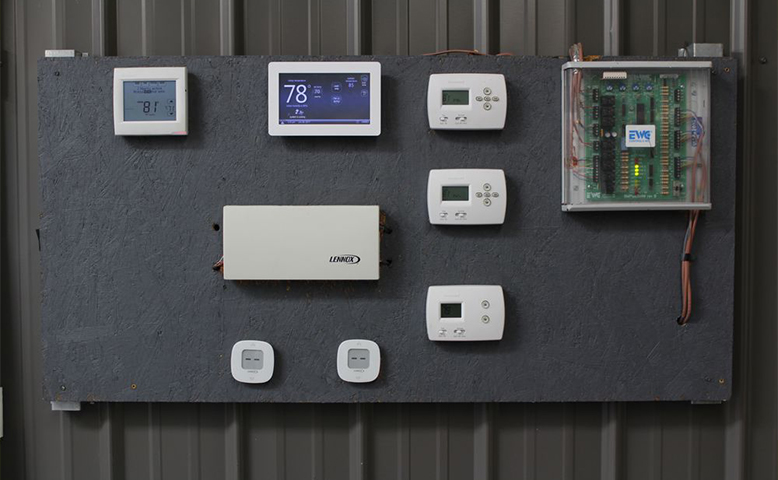
If your home suddenly feels too hot, too cold, it’s easy to blame your furnace or AC. But a lot of the time, the real problem is the thermostat. If you’re wondering, “Is my thermostat failing?” you’re definitely not alone.
A failing thermostat can make your system run at the wrong times, stop it from turning on, or cause uneven temperatures around the house. The good news is that there are clear warning signs you can look for before you end up with a full breakdown.
Here are 6 common signs your thermostat is failing:
- The room temperature doesn’t match the thermostat setting.
- Your HVAC turns on and off too often (short cycling).
- The thermostat display is blank, flickers, or acts glitchy.
- Your system won’t turn on, or won’t turn off.
- Temperature changes are slow or don’t happen at all.
- You get a weird schedule or programming behavior.
Below, we’ll walk you through each sign, what it usually means, what you can check safely on your own, and when it’s time to call a pro.
Before we jump into the signs, here’s a quick idea to keep in mind: a thermostat is like the “brain” of your heating and cooling. If the brain sends bad signals, the whole system behaves weird—even if the equipment is perfectly fine.
Also, some thermostat issues are simple (like dead batteries). Others point to wiring problems, a bad sensor, or a thermostat that’s just worn out.
1) The temperature doesn’t match what you set
This is the classic sign. You set your thermostat to 72°F, but the room feels like 78°F—or you’re shivering at 66°F.
Sometimes it’s not your imagination. Thermostats can lose accuracy as the temperature sensor ages or gets dusty.
What you can do right now:
- Put a simple indoor thermometer near the thermostat (not directly in sunlight).
- Wait about 15–20 minutes and compare readings.
- If the thermostat is off by more than a couple of degrees, that’s a red flag.
Fact: A thermostat reads the temperature only where it sits, not the whole house. If it’s near a drafty door, a sunny window, or a vent, it can “think” the house is hotter or colder than it really is.
2) Your system turns on and off too often (short cycling)
Short cycling means your furnace or AC starts, runs briefly, shuts off, then repeats. This can wear out parts faster and drive up your energy bill.
A failing thermostat can cause short cycling if it’s reading the temperature wrong, losing power briefly, or sending bad signals.
Common thermostat-related causes:
- Loose wiring behind the thermostat
- A thermostat mounted in a “bad spot” (near heat sources or vents)
- A failing internal sensor
Warning: Short cycling can also be caused by bigger HVAC issues (like airflow problems or an oversized system). If it keeps happening, don’t ignore it—your equipment can take a beating.
3) The display is blank, flickers, or acts glitchy
If your thermostat screen is blank, dim, randomly resets, or flickers, something isn’t right. Many thermostats run on batteries, while others get power from the HVAC system.
Try these quick checks:
- Replace the batteries (even if they “seem fine”).
- Make sure the thermostat is firmly attached to its base.
- Check your breaker panel for a tripped switch.
Quick Tip: If you have a smart thermostat, a weak power supply can cause random restarts, Wi-Fi drops, and schedule problems. A fresh set of batteries (or fixing the power connection) can make it behave normally again.
4) Your HVAC won’t turn on—or won’t turn off
This one gets stressful fast. You call for heat or cooling, and nothing happens. Or worse, the system keeps running no matter what you set.
A thermostat can fail in a way where it stops sending the “on” signal—or it gets stuck sending it.
Things to check safely:
- Make sure it’s set to the correct mode (Heat/Cool/Auto).
- Confirm the temperature setting is far enough from room temp (try 5 degrees).
- If it’s a programmable thermostat, test “Hold” mode to override the schedule.
Danger: If your system won’t turn off, switch the system off at the thermostat, and if it keeps running, shut it off at the breaker and call a professional. Constant running can overheat components and cause damage.
5) It reacts slowly, or your house never reaches the set temperature
If your thermostat calls for heat or AC, but the system seems sluggish—or it runs forever without reaching the target—your thermostat could be misreading the room temperature.
This often happens when:
- The thermostat sensor is failing
- Dust buildup interferes with readings
- The thermostat is installed on an exterior wall that’s colder/hotter than the room
Simple fix that sometimes helps:
- Gently dust around the thermostat cover (don’t spray cleaners into it).
- Make sure furniture, curtains, or décor aren’t blocking airflow around it.
If the thermostat is accurate but the home still won’t reach the set temperature, you might be dealing with HVAC capacity issues, insulation problems, or dirty filters. Thermostat problems are common—but not the only possible cause.
6) Weird programming or schedule behavior
If your thermostat changes temperatures on its own, ignores your schedule, or “forgets” settings, it may be failing—or it might just need a reset.
Smart thermostats can also bug out after power glitches or software updates.
What to try:
- Check that the time and date are correct.
- Reboot or reset the thermostat (follow the manual).
- Update firmware if it’s a smart model.
- If it keeps happening, the internal memory may be failing.
Suggestion: If your thermostat is more than 10 years old, upgrading can be worth it. Newer thermostats are more accurate, easier to program, and can help reduce energy waste when used correctly.
Conclusion
If your home temperature feels unpredictable, your system cycles oddly, or your thermostat acts glitchy, there’s a good chance the thermostat is the problem. The six biggest signs are mismatched temperatures, short cycling, display issues, systems that won’t turn on/off, slow temperature response, and strange scheduling behavior.
You can safely try basics like batteries, checking settings, and confirming the temperature reading with a separate thermometer. But if the system won’t shut off, keeps short cycling, or the problem keeps coming back, it’s smart to get a professional involved.
If you want a reliable fix without the guesswork, I’d suggest reaching out to A Plus Comfort Heating and Air Corp. They can quickly tell whether it’s the thermostat, wiring, or something else—and get your comfort back to normal.